
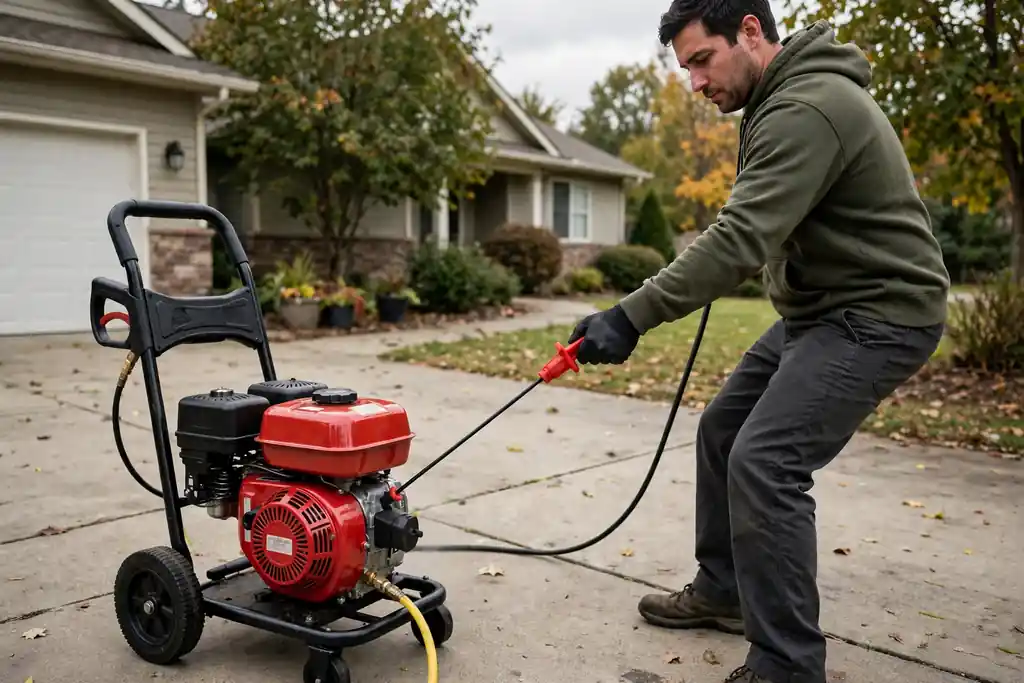
To start a Simpson pressure washer, connect the water supply, attach the spray gun and wand, squeeze the trigger to purge air, set the choke to the closed (full choke) position, turn the fuel valve on, engage the engine switch to “On,” prime the engine if cold, and pull the recoil starter cord firmly until the engine fires. Once running, open the choke gradually and allow the engine to warm before use.
Simpson pressure washers are among the most dependable gas-powered cleaning machines on the market, but first-time users and even experienced operators sometimes face confusion during the startup sequence. A missed step — like forgetting to purge air from the pump or skipping the choke adjustment — can prevent the engine from firing or damage the pump. This guide covers every detail of the startup process across all major Simpson pressure washer models, including cold start and warm start procedures, safety precautions, and common troubleshooting fixes.
Understanding Simpson Pressure Washer Models and Engine Types
Before learning how to start a Simpson pressure washer, it helps to understand which model and engine you are working with, because startup sequences can differ slightly depending on the power source, engine brand, and pump configuration.
Simpson Gas-Powered Pressure Washer Models
Simpson Manufacturing produces a broad lineup of gas-powered pressure washers that run on either a Honda GX series engine, a Kohler engine, or a Briggs & Stratton engine. The most widely used models include the Simpson Cleaning MegaShot, Simpson PowerShot, Simpson Aluminum Series, and the Simpson Pro Series. Each of these uses a gasoline-powered, air-cooled OHV engine paired with a Simpson AAA triplex plunger pump or a CAT pump depending on the tier.
PSI ratings across the Simpson lineup range from 2,000 PSI on entry-level units up to 4,400 PSI on professional-grade models. GPM (gallons per minute) flow rates typically range from 1.8 GPM to 4.0 GPM. The cleaning units (CU), calculated as PSI multiplied by GPM, determine the actual cleaning power delivered by the machine.
Simpson Electric Pressure Washer Models
Simpson electric pressure washers use an induction motor or universal motor and require a standard 120V household outlet or a 240V supply for higher-output models. The startup process for electric units is far simpler than for gas models: connect water, plug in the cord, and press the power switch. This guide focuses primarily on gas-powered units because they involve a more detailed and safety-sensitive startup procedure.
Key Components Involved in Startup
Understanding the physical components involved in startup helps you follow each step with intention rather than guesswork:
- Fuel tank — holds regular unleaded gasoline (minimum 87 octane)
- Fuel valve (petcock) — opens or closes the fuel line between tank and carburetor
- Choke lever — restricts airflow to enrich the fuel-air mixture during cold starts
- Throttle control — manages engine speed (RPM)
- Primer bulb — pushes fuel into the carburetor to aid cold starting
- Recoil starter (pull cord) — manually cranks the engine
- Engine on/off switch (ignition switch) — controls the kill circuit
- Spray gun and trigger — routes high-pressure water output
- High-pressure hose — connects pump outlet to spray gun
- Garden hose inlet — connects to the water supply source
- Nozzle tips (color-coded) — control spray angle and pressure
- Unloader valve — regulates pressure when the trigger is released
- Oil fill cap and dipstick — used to check crankcase oil level
Pre-Start Safety and Inspection Checklist
Starting a Simpson pressure washer without completing a pre-start inspection is one of the most common causes of pump damage, engine failure, and personal injury. The pump on a pressure washer is arguably more vulnerable than the engine during startup: running a pump without water supply (“dry running”) for even 30 seconds can cause irreversible damage to the seals, O-rings, and plunger surfaces inside the triplex pump.
Checking Engine Oil Level
Every Simpson gas pressure washer ships with little to no oil in the crankcase. This is a manufacturer practice to prevent leaks during shipping and is explicitly stated in every Simpson owner’s manual. New machines must have SAE 10W-30 motor oil added before the first start.
To check the oil level:
- Place the machine on a flat, level surface.
- Remove the oil fill cap/dipstick, wipe it clean, and reinsert it without threading it in.
- Withdraw the dipstick and check the oil level against the “Full” and “Add” marks.
- If low, add the manufacturer-recommended oil in small increments and recheck.
- Do not overfill — excess oil can cause blue smoke, fouled spark plugs, and engine damage.
The correct oil type for most Honda GX160, GX200, and GX390 engines used in Simpson machines is SAE 10W-30 for general temperatures. In cold climates below 32°F (0°C), SAE 5W-30 is recommended for easier starting.
Fueling the Pressure Washer
Use fresh, clean, regular unleaded gasoline with a minimum 87 octane rating. Ethanol-blended fuel (E10, containing up to 10% ethanol) is acceptable for short-term use but can cause carburetor gumming, fuel line degradation, and starting issues if left sitting for more than 30 days. For long-term storage or seasonal machines, use ethanol-free gasoline or add a fuel stabilizer such as STA-BIL to the tank.
Never use E15 or E85 fuel in a Simpson pressure washer engine. The higher ethanol content damages rubber fuel lines, carburetor float components, and diaphragm seals not designed for high-ethanol blends.
Fill the fuel tank to no more than 1/4 inch below the top of the filler neck to allow space for fuel expansion. Wipe up any spilled gasoline immediately before starting.
Inspecting the High-Pressure Hose and Connections
Inspect the high-pressure hose (typically a 25-foot or 50-foot rubber-wrapped or thermoplastic hose rated for 3,000–4,000 PSI) for any cracks, bulges, kinks, or damaged couplings. A hose failure under full pressure can cause a high-pressure water injection injury, which is a serious medical emergency. Replace any hose that shows signs of wear before starting the unit.
Connect the garden hose (minimum 5/8-inch diameter) to the water inlet port on the pump. Use a garden hose washer inside the coupling to prevent leaks. Connect the other end to a functioning water source capable of supplying at least 1.5 to 2.5 GPM continuously — the specific requirement matches the machine’s rated GPM output. An insufficient water supply causes cavitation in the pump, which sounds like rattling gravel and accelerates pump wear.
Connect the high-pressure hose to the pump outlet and to the spray gun. Attach the appropriate color-coded nozzle tip to the spray wand:
| Nozzle Color | Spray Angle | Best Use |
|---|---|---|
| Red (0°) | Pinpoint jet | Stubborn stains, concrete etching |
| Yellow (15°) | Narrow fan | Stripping paint, heavy grime |
| Green (25°) | Medium fan | General surface cleaning |
| White (40°) | Wide fan | Delicate surfaces, cars, wood |
| Black (65°) | Low-pressure soaking | Applying detergent |
For startup, the green (25°) nozzle is a neutral choice that allows safe water flow during the air-purge step.
Step-by-Step: How to Start a Simpson Pressure Washer (Cold Start)
A cold start refers to starting the engine when it has been sitting and the engine block and carburetor are at ambient temperature. This requires choke use and sometimes priming, depending on the model.
Step 1: Connect and Turn On the Water Supply
Turn on the water supply valve fully before starting the engine. This is non-negotiable. The pump must have a continuous water supply before the engine fires.
Connect the garden hose and turn the outdoor spigot to full open. Allow water to flow through the system by squeezing the spray gun trigger until a steady, air-free stream of water exits the nozzle. This purges air from the pump, hose, and wand. Air pockets inside the pump can cause cavitation damage and prevent the pump from building pressure.
Hold the trigger open until water flows smoothly with no sputtering. This typically takes 10 to 30 seconds depending on hose length.
Step 2: Set the Choke to the Closed (Full Choke) Position
Locate the choke lever on the engine. On Honda GX series engines, the choke lever is typically on the left side of the air filter housing. Move the lever to the fully closed position, which is usually indicated by a solid bar symbol or the word “CHOKE” on the housing label.
The choke closes a butterfly valve in the carburetor throat, reducing airflow and creating a richer fuel-air mixture. This makes cold-start ignition more reliable because cold fuel does not vaporize as readily as warm fuel.
If the engine has been running recently and is still warm (within the last 30 minutes), skip this step or use only half-choke to avoid flooding the carburetor.
Step 3: Turn the Fuel Valve to the “On” Position
The fuel shutoff valve (petcock) is located on the bottom or side of the fuel tank and connects to the carburetor bowl via a short fuel line. Move the lever to the “ON” or “OPEN” position to allow fuel to flow to the carburetor.
Leaving the fuel valve closed is one of the most common reasons a Simpson pressure washer will not start: the engine may fire for one or two pulls from residual fuel in the carburetor bowl and then immediately die.
Step 4: Prime the Engine (If Equipped with a Primer Bulb)
Some Simpson models equipped with Briggs & Stratton engines have a primer bulb — a small rubber dome located near the carburetor. Press the primer bulb three times slowly to push fuel directly into the carburetor throat. This replaces the need for multiple pull attempts to draw fuel up through the fuel line on the first start.
Honda GX engines do not typically use a primer bulb. They rely on the choke and recoil starter alone. If your Simpson unit has a Honda engine and there is no primer bulb, skip this step.
Step 5: Set the Throttle to the “Fast” or “High” Position
Move the throttle lever to the fast (rabbit) position or to the position marked “HIGH” or with an upward arrow. Starting a pressure washer engine at high throttle ensures the engine reaches sufficient RPM quickly after firing, which helps it sustain combustion rather than stalling.
Some operators try to start with throttle at mid-position, which can cause the engine to fire weakly and then stall before it fully warms up.
Step 6: Turn the Engine Switch to the “On” Position
The engine on/off switch is a simple kill-circuit toggle. Move it to the “ON” (or “RUN”) position. If this switch is in the “OFF” position, the ignition is grounded and the spark plug will not fire regardless of how many times you pull the cord. This is another very common reason new users struggle to start the machine.
Step 7: Pull the Recoil Starter Cord
Stand beside the machine with one hand firmly gripping the frame or handle for stability. Grip the recoil starter handle with your dominant hand and pull it slowly until you feel resistance (this is the engine reaching the compression stroke). From that point, pull sharply and quickly with full arm extension. Do not pull the cord all the way out to its full length and let it snap back — this damages the recoil spring inside the starter assembly.
On a properly prepared engine with fresh fuel and correct oil, most Simpson pressure washers start within 2 to 5 pull attempts during a cold start.
If the engine fires but immediately stalls, it is likely a sign the choke needs to remain closed for a moment longer, or the engine needs another primer bulb press if equipped.
Step 8: Gradually Open the Choke After the Engine Fires
Once the engine is running, allow it to idle for 30 to 60 seconds with the choke still in the closed or half-closed position. Then slowly move the choke lever toward the fully open position. Moving from full choke to open choke too quickly on a cold engine causes the engine to stumble or stall because the fuel-air mixture becomes too lean before the engine reaches operating temperature.
After the engine has run for 1 to 2 minutes and is fully warmed, the throttle can remain at the “FAST” position for full-pressure operation.
How to Start a Simpson Pressure Washer (Warm Start)
A warm restart is performed when the engine was recently running and is still at or near operating temperature. The procedure is simpler because the fuel in the carburetor is already warm and vaporizes readily.
For a warm start:
- Confirm water supply is connected and on.
- Leave the choke in the fully open position — do not close it.
- Confirm the fuel valve is open.
- Confirm the engine switch is set to “ON.”
- Set the throttle to “FAST.”
- Pull the recoil starter cord once or twice with a brisk, decisive pull.
Most warm starts on a Simpson pressure washer require only one pull when the engine is healthy. If the machine repeatedly requires many pulls even when warm, inspect the spark plug, carburetor, and fuel quality.
How to Start a Simpson Electric Pressure Washer
Simpson electric pressure washers are significantly easier to start than gas models. The startup process takes under one minute:
- Connect the garden hose to the water inlet and turn on the water supply.
- Connect the high-pressure hose to the pump outlet and to the spray gun.
- Attach the appropriate nozzle tip.
- Squeeze the spray gun trigger to purge air from the system.
- Plug the power cord into a GFCI-protected outlet of the correct voltage (120V or 240V depending on the model).
- Press the power switch or trigger switch to “ON.”
- Squeeze the spray gun trigger to begin operation.
Always use an outdoor-rated extension cord of adequate gauge if needed. For 120V Simpson electric models, a 12-gauge, 50-foot extension cord is the maximum recommended length to avoid voltage drop and motor overheating. Using an undersized extension cord causes premature motor burnout, which is not covered under the manufacturer’s warranty.
Operating the Simpson Pressure Washer After Starting
Adjusting Pressure and Nozzle Selection
After the engine is running and warmed up, you can begin cleaning operations. Pressure adjustment on most Simpson gas pressure washers is handled by nozzle selection rather than a dial or knob on the pump. The PSI output of the machine remains constant at the rated value; the spray angle of the nozzle tip changes how that pressure is distributed across a surface area.
For maximum concentrated pressure, use the red 0° nozzle. For general cleaning, use the green 25° nozzle. For detergent application, attach the black low-pressure nozzle and connect a detergent siphon tube to the chemical injection port on the pump inlet.
Some higher-end Simpson models feature a variable pressure dial or adjustable unloader valve that allows PSI reduction without changing nozzles. Consult your specific model’s owner’s manual for this feature.
Using the Detergent Injection System
Simpson pressure washers equipped with a downstream chemical injector allow soap to be drawn through the pump at low pressure. Only use the detergent injection system when the black (soaping) nozzle is attached — the low pressure created by the wide-angle nozzle activates the venturi effect in the injector that draws soap from the container.
Use only pressure washer-safe detergents and always dilute per the manufacturer’s recommendation. Do not use household bleach through the chemical injector unless your model explicitly states it is compatible with chlorine solutions; bleach can corrode O-rings, seals, and brass fittings in the pump.
Pausing and Restarting Mid-Job
When you need to pause cleaning for more than 2 to 3 minutes, do not leave the engine running with the trigger locked or closed. The unloader valve bypasses water back to the pump inlet when the trigger is not pressed, but continuous bypass circulation generates heat that can damage pump seals in as little as 2 to 3 minutes on a hot day.
Best practice: release the trigger, turn the engine off, and restart when ready. The warm-start procedure takes only seconds and prevents unnecessary pump wear.
Troubleshooting: Simpson Pressure Washer Won’t Start
Engine Cranks But Does Not Fire
If the pull cord moves freely but the engine does not catch, suspect:
- Empty or stale fuel — drain the tank and refill with fresh gasoline.
- Closed fuel valve — confirm the petcock is in the “ON” position.
- Flooded carburetor — move the choke to fully open, set throttle to fast, and pull 10 to 15 times without choking to clear excess fuel.
- Faulty or fouled spark plug — remove the spark plug (typically NGK BPR6ES or Champion RJ19LM depending on the engine), inspect the electrode for carbon buildup or damage, clean with a wire brush, check the spark gap (typically 0.030 inches), and replace if worn.
- Dirty air filter — remove the foam or paper air filter element, clean or replace it.
Engine Starts Then Immediately Stalls
This almost always indicates a carburetor fuel delivery problem, specifically a clogged carburetor main jet caused by varnish from old fuel. Remove and clean the carburetor, or replace the carburetor assembly (a low-cost part available from Simpson dealers or online parts suppliers).
It can also indicate the choke is opening too fast before the engine reaches operating temperature — keep the choke at half position for 1 to 2 more minutes before fully opening.
Pressure Washer Starts But Has No Water Pressure
If the engine runs but the pressure washer produces weak or no pressure, check:
- Water supply is fully open and adequate GPM is reaching the inlet.
- Nozzle tip is not clogged — rinse or soak in warm water.
- Air is still trapped in the pump — stop the engine, squeeze the trigger to release trapped air, and restart.
- Unloader valve is stuck — the unloader may need cleaning or replacement.
- Pump inlet filter screen is clogged — remove and clean the inline screen.
Pull Cord Is Hard to Pull or Stuck
A pull cord that is extremely stiff or will not move at all usually means:
- Hydrolocked pump — water has entered the pump crankcase (serious mechanical issue, requires pump disassembly).
- Engine is seized due to running without oil — this requires engine replacement.
- Recoil starter mechanism is jammed — inspect the starter assembly for tangled cord or broken pawl.
Simpson Pressure Washer Maintenance After Starting and Use
Flushing the Pump After Use
After every use, run clean water through the pump for 2 minutes before shutting down to flush out detergent residues and debris. Residual soap left in the pump accelerates seal degradation and can cause corrosion inside the plunger housing.
Winterizing a Simpson Pressure Washer
If storing the machine in temperatures below 32°F (0°C), water trapped inside the pump will freeze and crack the pump housing, valves, and fittings — a costly repair. To winterize:
- Flush the pump with clean water.
- Run pump saver/antifreeze lubricant (such as Briggs & Stratton Pump Saver or Simpson’s own pump storage fluid) through the inlet until it exits the outlet wand.
- Drain the fuel tank, or add fuel stabilizer and run the engine for 2 minutes to distribute it through the carburetor.
- Store the machine upright in a dry, frost-free location.
Spark Plug and Oil Change Intervals
Replace the spark plug every 100 hours of operation or once per season. Change the engine oil after the first 5 hours of break-in operation and then every 50 hours or once per season thereafter. Use manufacturer-approved oil — for Honda GX engines, Honda recommends Honda GN4 10W-30 motor oil, though any quality SAE 10W-30 API SJ or higher oil is acceptable.
Frequently Asked Questions
How to start a Simpson pressure washer for the very first time out of the box?
For the first start of a brand-new Simpson pressure washer, you must add engine oil before any other step because the crankcase ships dry. Add SAE 10W-30 oil to the “Full” mark on the dipstick, then add fresh unleaded gasoline to the fuel tank. Connect the water supply, attach the spray gun and hose, squeeze the trigger to purge air, set the choke to closed, open the fuel valve, turn the ignition switch to ON, set the throttle to FAST, and pull the recoil starter cord with a firm, brisk pull. Expect 3 to 5 pulls for the first start. Once the engine fires and warms for about 60 seconds, gradually open the choke to the full open position.
Why does my Simpson pressure washer start but then shut off immediately?
A Simpson pressure washer that starts and immediately shuts off is most often caused by a clogged or gummed carburetor from stale fuel left sitting in the system. Ethanol in gasoline absorbs moisture and leaves behind a sticky varnish that blocks the carburetor’s main jet and pilot circuit. Clean or replace the carburetor. Other causes include an incorrectly adjusted choke (opening too soon before warm-up), a dirty spark plug, or a faulty low-oil shutdown sensor on models equipped with this safety feature — if the oil level is borderline, the sensor may cut the engine even when oil is present. Check oil level and top off if needed.
How do you start a Simpson pressure washer after it has been stored all winter?
Starting a Simpson pressure washer after winter storage requires a few extra steps because fuel degrades over time. First, drain any old gasoline from the tank and add fresh fuel. If the carburetor has varnish buildup from old fuel, add carburetor cleaner to the tank or remove and clean the carburetor manually. Check the engine oil and replace if it looks dark or milky. Inspect the air filter and replace if dirty. Remove and inspect the spark plug — replace it if the electrode is worn. Connect water, purge air from the pump by squeezing the trigger, set the choke to fully closed, turn on the fuel valve, set throttle to FAST, and pull the starter cord.
How do I know when to use the choke on my Simpson pressure washer?
Use the full choke position on a Simpson pressure washer only during a cold start — when the engine has been off for more than 30 minutes and the engine block is at ambient temperature. For a warm start (engine recently running), leave the choke fully open. Using full choke on a warm engine floods the carburetor with excess fuel, making starting harder and potentially fouling the spark plug. If you are unsure whether the engine is warm or cold, start with half-choke; if the engine fires quickly, move to full open immediately.
What kind of gas does a Simpson pressure washer take?
Simpson pressure washers require regular unleaded gasoline with a minimum 87 octane rating. Gasoline blended with up to 10% ethanol (E10) is acceptable for short-term use. Avoid E15 and E85 fuels entirely — these contain higher ethanol concentrations that damage rubber fuel lines, carburetor internals, and fuel system seals not rated for high-ethanol blends. For seasonal machines stored for more than 30 days, use ethanol-free gasoline or add a quality fuel stabilizer like STA-BIL 360 to preserve the fuel. Do not use diesel fuel or mixed two-stroke fuel in a Simpson pressure washer engine, as all models use four-stroke gasoline engines.
How many times should I pull the cord to start a Simpson pressure washer?
A properly prepared Simpson pressure washer with fresh fuel, correct oil level, clean spark plug, and correct choke setting should start within 2 to 5 pull attempts during a cold start. If it requires more than 6 to 8 pulls, something in the preparation sequence is incorrect. The most common issues are a closed fuel valve, choke set incorrectly, stale fuel, or a fouled spark plug. A warm Simpson pressure washer should start on the first or second pull. Avoid pulling the cord to its full extension on every attempt — this strains the recoil spring and can break the starter mechanism over time.
Can I start a Simpson pressure washer without water connected?
No. You must never start a Simpson pressure washer without a water supply connected and turned on. Running the pump without water — known as dry running — causes the pump seals, O-rings, and ceramic plunger surfaces to overheat and fail within seconds. Most Simpson AAA triplex pumps and CAT pumps used in Simpson machines are not self-priming in the sense of running without water; they require a continuous water supply to function. Even a few seconds of dry operation can void the pump warranty and require costly repair or pump replacement.
Why is my Simpson pressure washer hard to pull and won’t start?
A Simpson pressure washer with a very stiff pull cord that barely moves is often experiencing a hydrolocked condition — water has entered the engine cylinder or pump crankcase and cannot be compressed by the piston. This happens when water travels backward through the pump into the engine, particularly if the machine was stored incorrectly. To resolve this, remove the spark plug and pull the cord several times to expel water from the cylinder. If the pump is hydrolocked, the pump crankcase drain plug must be removed to clear water. A completely locked engine that will not turn even with the spark plug removed likely has a seized piston from operating without oil and requires professional service or engine replacement.
How do I start a Simpson MegaShot pressure washer specifically?
The Simpson MegaShot series (models such as MS60763, MS60764, and MS60773) is powered by a Honda GC190 engine rated at 3,300 PSI / 2.5 GPM. To start the Simpson MegaShot: connect and turn on the water supply, attach the spray gun and hose, squeeze the trigger to purge air, move the fuel valve to ON, set the choke lever to CLOSED, move the throttle to FAST, turn the engine switch to ON, and pull the recoil cord firmly. The GC190 engine in the MegaShot is known for reliable one- to three-pull starts when properly maintained. Unlike the GX series, the GC190 does not have an oil alert shutoff sensor as a standard feature on all variants, so verifying oil level manually before every start is important.
Conclusion
Starting a Simpson pressure washer correctly comes down to following a defined sequence: verify oil and fuel, connect water, purge air from the pump, set the choke, open the fuel valve, engage the ignition switch, and pull the starter cord with confidence. Whether you own a Simpson MegaShot, PowerShot, Aluminum Series, or any other model powered by a Honda, Kohler, or Briggs & Stratton engine, the fundamental startup logic remains the same. Skipping the air purge step or starting without water are the two most damaging mistakes. With correct preparation, a Simpson pressure washer starts reliably every time and delivers consistent, high-performance cleaning for years of service.