
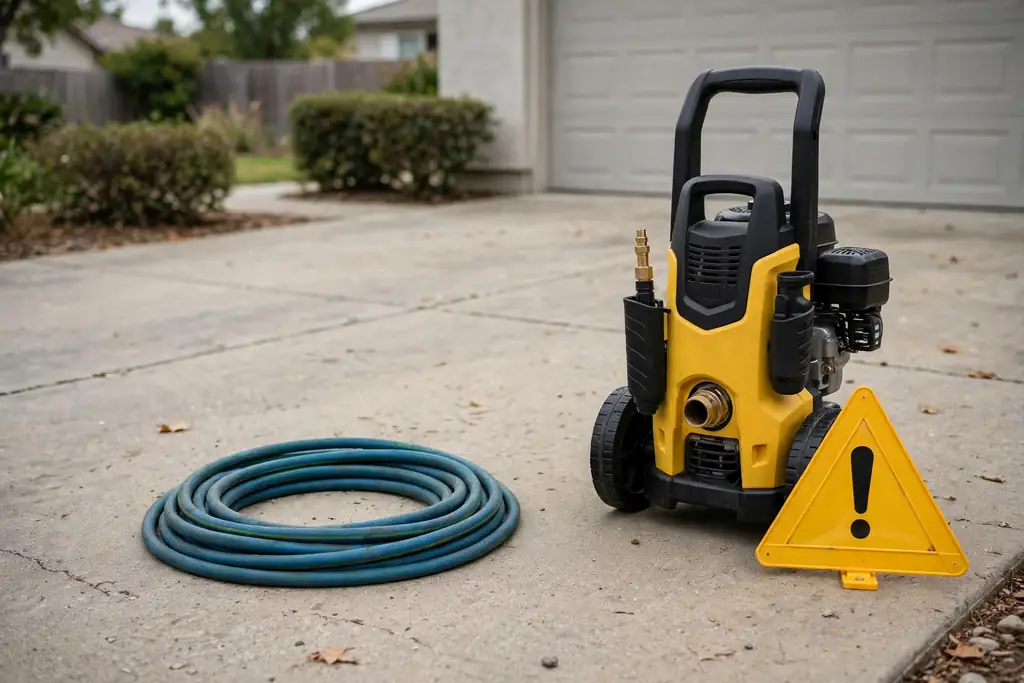
No, you should never start a pressure washer without water connected and flowing through the pump. Running a pressure washer dry — even for as little as 30 seconds — causes the pump’s ceramic plungers, packing seals, and valve seats to overheat from friction, leading to permanent seal degradation, scoring of precision internal surfaces, and in many cases complete pump failure requiring full replacement.
This is one of the most common and most expensive mistakes pressure washer owners make, often without realizing it happened at all. The damage from dry-running does not always manifest as an immediate, obvious failure. Sometimes the machine appears to work fine after a brief dry-run but delivers reduced pressure the following season as internally compromised seals swell, crack, and lose their sealing effectiveness. Other times the pump fails immediately and completely. Either way, the cause is the same — operating the machine without water performing its essential dual role as both a hydraulic working fluid and a thermal coolant inside the pump assembly.
Understanding exactly why water is so critical, what happens mechanically during a dry-run event, how quickly damage occurs, and how to safely set up and start your machine every single time is the knowledge that separates operators who get 10-plus years from their equipment from those replacing pumps every two seasons.
Why Water Is Not Optional: The Physics of Pressure Washer Pump Operation
To understand why you cannot start a pressure washer without water, you first need to understand what water actually does inside a pressure washer pump beyond the obvious function of being the fluid that gets sprayed out.
Water as a Lubricant and Coolant Inside the Pump
A pressure washer pump is not lubricated by oil in the same way an engine is. The pump crankcase contains oil that lubricates the connecting rods, crankshaft bearings, and cam lobes on the mechanical side of the pump. But the hydraulic side of the pump — the chambers where water is actually compressed — uses water itself as the primary lubricating and cooling medium for the ceramic plungers, packing seals (also called lip seals or V-packings), and valve seats.
When water flows continuously through the pump at rated GPM (gallons per minute), it forms a microscopic film between the moving ceramic plunger surface and the stationary packing seal that prevents direct metal-to-dry-rubber contact during each stroke. It simultaneously absorbs the frictional heat generated by that contact and carries it away through the outlet. This is a continuous, self-refreshing lubrication and cooling cycle that only functions when water is present and flowing.
Remove the water and the plunger strokes against the packing seal with no lubricating film, no heat dissipation, and no hydraulic cushioning. The resulting friction generates heat so rapidly — within seconds on a full-speed pump — that the PTFE-impregnated rubber or polyurethane packing seals exceed their thermal tolerance threshold, harden, lose elasticity, and begin to physically disintegrate. The ceramic plunger surface, though extremely hard, develops micro-scoring from contact with degraded seal material that travels through the pump chamber.
The Role of Water in Thermal Management
A triplex plunger pump on a professional-grade gas pressure washer operates at 1,400–1,800 strokes per minute at full throttle. Each stroke compresses water against the resistance of the downstream nozzle, generating significant hydraulic work. The energy that goes into that compression cycle produces heat — heat that water flowing at 2.5–4.0 GPM continuously absorbs and removes from the system.
Without water flow, that thermal energy has nowhere to go. The pump body — typically made from aluminum alloy, brass, or cast iron depending on the model — acts as a heat sink, but its thermal mass is quickly overwhelmed. Axial cam pumps, which are lighter and more compact than triplex pumps, have even less thermal mass and overheat faster. Pump body temperatures during dry running have been measured exceeding 200°F (93°C) within 30–45 seconds of operation on full-throttle residential machines, well above the maximum continuous operating temperature of most pump seal compounds.
The Unloader Valve Dependency on Water Flow
The unloader valve (also called a pressure regulator valve or bypass valve) is a spring-loaded component that diverts water back to the pump inlet when the trigger gun is in the released position. This bypass circuit allows the pump to keep running without building destructive pressure when no spray is demanded. However, this bypass circuit still requires water to flow — it simply routes the water in a loop rather than out the nozzle.
When there is no water in the system at all, the unloader valve has nothing to bypass. The pump attempts to move fluid that does not exist, the plungers stroke against air, and the complete absence of hydraulic resistance causes the unloader valve spring to hold the valve wide open continuously — a condition the valve is not designed for under sustained dry-run circumstances.
What Components Are Damaged by Dry-Running a Pressure Washer
Packing Seals (Pump Seals)
Packing seals are the first components to fail during a dry-run event and the most frequently replaced components in pressure washer pump service. They are made from engineered polymers including polyurethane, nitrile rubber (NBR), EPDM rubber, or Viton (FKM) depending on the pump model and the chemical compatibility requirements of the application.
These materials are selected for their flexibility, resilience, and ability to form a dynamic seal against the reciprocating ceramic plunger while remaining soft enough not to score the plunger surface. All of these properties depend on the seal material remaining within its operating temperature range — typically -20°F to 180°F (-29°C to 82°C) for polyurethane seals. Above this threshold, the material hardens permanently, loses its ability to conform to the plunger surface, and develops micro-cracks that allow pressurized water to bypass the seal during operation.
Seal replacement kits for most pump brands cost between $15 and $60 and include all packing seals, O-rings, and valve components. On an AR pump (made by Annovi Reverberi), a General Pump, a Cat Pump, or a Comet pump — the four largest OEM pump manufacturers supplying the pressure washer industry — seal kits are widely available and the replacement procedure is within the capability of a mechanically confident owner. However, if a dry-run event has also damaged the ceramic plungers or scored the pump manifold bores, seal replacement alone will not restore the pump to full performance.
Ceramic Plungers
Ceramic plungers (also called ceramic pistons or ceramic rods) are the reciprocating elements that create compression inside the pump chamber. They are manufactured from alumina ceramic or zirconia ceramic — extremely hard, dimensionally stable materials chosen for their wear resistance and corrosion immunity. Under normal water-lubricated operation, ceramic plungers can last thousands of hours before showing meaningful wear.
During a dry-run event, the superheated and degrading packing seal material acts as an abrasive against the ceramic plunger surface. Ceramic is hard but not immune to surface scoring from embedded abrasive particles. Once a ceramic plunger is scored — even with scratches visible only under magnification — the seal cannot form an effective dynamic seal against the damaged surface regardless of how new the replacement seal is. The scored plunger must be replaced alongside the seals for a successful pump rebuild.
Ceramic plunger replacement is more expensive than seal replacement alone, typically $20–$80 per plunger depending on the pump model, and a triplex pump has three plungers. On consumer-grade axial cam pumps, the plunger assembly is often not serviceable separately from the pump housing, meaning the entire pump requires replacement.
Check Valves (Inlet and Outlet Valves)
Check valves inside the pump manifold control the one-way flow of water through each compression chamber. Each chamber has one inlet check valve that opens during the intake stroke and one outlet check valve that opens during the compression stroke. During a dry-run event, the absence of water means these valves are cycling against air rather than fluid.
The spring-loaded valve seats and valve balls (or poppet discs) in check valves are designed to cushion their closing impact with a hydraulic buffer from the water column. Without that buffer, the valve seats against its stop with direct mechanical impact on each cycle — a condition called hydraulic hammering without dampening. Over even a brief dry-run period, this repeated hard-seating can dent or chip the valve seat surface, causing the valve to leak past its seat under pressure and reducing pump output.
The Pump Manifold Body
The pump manifold (also called the pump head or pump cylinder block) is the structural housing that contains the compression chambers, check valve bores, and plunger guides. In triplex pumps, the manifold is typically made from brass or stainless steel and is highly resistant to thermal damage from brief dry-run events. In axial cam pumps found in consumer-grade machines from Sun Joe, Ryobi, Greenworks, and Karcher, the manifold is often made from aluminum alloy or even reinforced thermoplastic in the most economical models.
Aluminum manifolds transmit heat faster and are more vulnerable to warp damage from thermal shock. If a hot dry-run manifold is suddenly flooded with cold water, the rapid thermal gradient can cause micro-cracking of the aluminum casting — damage that may not be immediately visible but creates hairline pressure leaks that worsen progressively under repeated pressurization cycles.
How Long Can a Pressure Washer Run Without Water Before Damage Occurs?
This is the question most owners ask after an accidental dry-run event, and the honest answer is that it depends on the machine type, pump design, operating speed, and ambient temperature. There is no universal safe dry-run duration, but the following framework represents realistic field experience:
| Machine Type | Pump Type | Approximate Damage Threshold | Typical Outcome After Threshold |
|---|---|---|---|
| Budget electric (under $150) | Induction motor, plastic axial pump | 5–15 seconds | Seal failure, pump replacement likely |
| Mid-range electric ($150–$350) | Brushless or induction, aluminum axial pump | 15–30 seconds | Seal damage, possible plunger scoring |
| Heavy-duty electric ($350+) | Aluminum or brass axial pump | 20–40 seconds | Seal replacement typically resolves issue |
| Consumer gas ($300–$600) | Aluminum axial cam pump | 15–30 seconds | Seal failure, plunger scoring possible |
| Professional gas ($600–$1,500) | Brass or cast iron triplex pump | 30–60 seconds | Seal damage, usually rebuildable |
| Commercial/industrial ($1,500+) | Stainless or cast iron triplex pump | 45–90 seconds | Seal replacement, rarely structural damage |
These timeframes assume the engine or motor is running at full operating speed. A machine started at partial throttle before advancing to full speed during a dry-run event may have slightly more tolerance at lower RPM, but this should not be relied upon as a safety margin.
The critical insight that competitor articles rarely explain clearly is this: there is no safe dry-run duration for any pressure washer. The damage threshold figures above are estimates of when permanent damage becomes highly likely — not a window during which operation is acceptable. The correct dry-run duration to target is always zero seconds.
How to Properly Start a Pressure Washer With Water: Step-by-Step Guide
Step 1: Connect the Water Supply Before Touching Any Controls
The foundational rule is absolute: water must flow before the engine or motor starts. Connect a ¾-inch diameter garden hose from a fully functioning water tap directly to the machine’s water inlet port. Turn the water tap to its fully open position.
Do not begin this process with a kinked hose, a partially closed tap, a tap known to have low pressure, or a corroded or debris-blocked inlet filter. Any of these conditions restricts water flow to the pump and can create a partial-starvation condition that, while less immediately damaging than complete dry-running, degrades pump seals through inadequate lubrication over repeated sessions.
Step 2: Purge Air From the System Before Starting
Before starting the engine or motor, squeeze the trigger gun and hold it in the open position while the water supply is running. You will see water flow through the system, out the wand, and eventually through the nozzle. Continue holding the trigger open until the water flow becomes smooth and continuous with no spluttering, coughing, or intermittent spray — these irregular flow patterns indicate that air pockets are still present in the pump and hose system.
Air purging is a critical step that many operators skip because the machine technically starts and runs with air in the system. The problem is that air pockets cause hydraulic hammer inside the pump chambers as the plunger tries to compress an incompressible liquid (water) against a compressible void (air pocket) in rapid alternation. This creates pressure spikes that stress check valves, packing seals, and manifold fittings well above their designed operating loads. A 30-second air purge before startup prevents this entirely.
Step 3: Keep the Trigger Open During Startup
For both electric pressure washers and gas pressure washers, start the machine with the trigger gun held open so that water flows freely through the pump as the motor or engine comes up to operating speed. This ensures the pump is water-filled and water-lubricated from the very first revolution.
On electric models, turn the power switch on while holding the trigger. On gas models, complete the startup sequence (choke, fuel valve, throttle position) and pull the recoil starter while your partner or assistant holds the trigger open — or use a trigger lock in the open position if your gun has one. Once the machine is running and producing steady pressure, release the trigger to normal operation.
This technique ensures there is zero interval between pump startup and water flow through the pump chambers. It is a simple habit that effectively eliminates dry-run risk during the startup phase.
Step 4: Verify Pressure Before Beginning Work
After startup, squeeze the trigger and observe the spray character before beginning the cleaning task. A healthy machine producing full pressure will deliver a sharp, consistent spray pattern with immediate high-velocity response to trigger activation. A machine with air still in the system, or one with early seal wear, will produce an inconsistent or pulsating spray during the first few seconds of operation.
If pulsation or irregular spray continues for more than 15–20 seconds after startup, stop the machine, inspect all hose connections for tightness, confirm the water supply is fully open, and check the inlet filter screen for blockage before proceeding.
Step 5: Never Leave the Machine Running With the Trigger Released for Extended Periods
When you release the trigger on a running pressure washer, the unloader valve diverts water into a bypass loop that routes it back to the pump inlet. This keeps the pump internally water-filled and protected even with no spray output. However, this bypass loop generates its own heat through the energy of continuous pump operation, and that heat accumulates in the water circulating through the bypass circuit.
Most manufacturers specify a maximum continuous trigger-released run time of 2–5 minutes before the bypass water becomes hot enough to degrade pump seals through sustained elevated temperature — even though the machine is fully primed with water. This is sometimes called thermal bypass failure and is distinct from dry-run damage but produces similar seal degradation over time.
If you need to pause spraying for more than 2–3 minutes, turn the machine off rather than letting it idle. This protects both the pump seals and the engine or motor from unnecessary wear during a non-productive run period.
Accidental Dry-Run: What to Do Immediately
Immediate Response Steps
If you accidentally start or run a pressure washer without water connected, the priority response is:
Turn the machine off immediately. Do not wait to see if it “seems okay.” Turn off the motor or engine the moment you realize the water supply is disconnected or not flowing. Every additional second of operation without water increases the severity of the damage.
Do not immediately flood the pump with cold water. If the pump is hot from a dry-run event, connecting cold water suddenly creates a thermal shock condition. Allow the pump to cool for 5–10 minutes at ambient temperature before connecting the water supply.
After cooling, connect water and attempt normal startup following the procedure above. If the machine starts and runs but delivers reduced pressure, or if you hear unusual noises (rattling, grinding, or high-pitched squealing from the pump area), stop immediately. These are signs of seal or valve damage requiring inspection before continued operation.
How to Assess the Damage
A simple field assessment after an accidental dry-run involves running the machine with water fully connected for 2–3 minutes and checking for:
Water leaking from around the pump packing area indicates seal failure. Weeping water from the area where the plungers enter the pump manifold confirms that packing seals have lost their sealing integrity and require replacement.
Pressure significantly below rated specification (more than 20 percent low) suggests check valve damage or seal bypass allowing water to recirculate internally rather than building to full pressure. A pressure gauge connected inline will quantify this deficit precisely.
Visible oil mixed with the spray water — appearing as an oily sheen in the water stream — indicates that the thermal barrier between the oil-side crankcase and the water-side pump chambers has been breached, meaning internal structural damage has occurred and pump replacement is likely necessary.
Unusual pump noise (grinding, knocking, or metallic rattling) after a dry-run event suggests ceramic plunger scoring or mechanical damage to the pump internals that seal replacement alone will not fix.
Dry-Running Risk Scenarios: When It Happens Accidentally
Understanding the specific situations that cause accidental dry-running helps you build habits that prevent them. These are the most common real-world scenarios:
Forgetting to open the water tap: The most straightforward scenario — the garden hose is connected but the tap remains closed. The machine starts and the pump immediately runs dry. Prevention: develop a consistent startup sequence that always includes confirming water flow before engine startup.
Running the supply hose dry from a tank or bucket: When using a gravity-fed water tank or water buffalo as the supply source rather than a tap, the tank runs empty mid-operation and the pump transitions from water-fed to air-fed without any warning. Prevention: use a low-water shutoff float valve on the tank inlet, and never use a supply tank smaller than 20 gallons for sustained operation without monitoring.
Air lock in the supply hose: A long garden hose left coiled in a warm location can develop an air pocket inside from thermal off-gassing of dissolved gases in the water. When this air pocket reaches the pump during operation, it briefly starves the pump of water. Prevention: purge the garden hose by running water through it before connecting to the machine.
Kinked or frozen supply hose: A kinked garden hose, a frozen section of hose during cold weather operation, or a partially clogged inlet filter creates flow restriction that can starve the pump. This is a partial dry-run condition — water flows but not at sufficient rate to adequately lubricate and cool the pump. Prevention: inspect hose routing before each use, replace the inlet filter regularly, and use a hose diameter appropriate for your machine’s rated GPM.
Nozzle tip blockage during operation: A clogged nozzle orifice causes a complete flow stoppage at the outlet while the pump continues to run. Since the unloader valve opens to bypass the water in this condition, the pump remains water-filled through the bypass loop and is not technically running dry. However, sustained operation with a blocked nozzle strains the unloader valve spring and can cause thermal bypass failure. Prevention: clear blocked nozzles by removing them and flushing with clean water before reinstalling.
Starting the machine before the trigger gun is connected: Some users start the engine or motor before attaching the spray gun and hose assembly, intending to connect everything once the engine is running. During this interval, the pump outlet has no downstream restriction and no water exits — but with no backpressure and no water supply connected, the pump runs dry. Prevention: always assemble the complete system — water supply, hose, gun, wand, nozzle — before starting.
Common Mistakes That Lead to Dry-Running a Pressure Washer
Rushing through startup: The most common underlying cause of dry-run events is simply working too fast. Operators who start the engine before confirming water flow, or who connect the supply hose to a partially closed tap and miss the absence of flow, create the conditions for dry-running through inattention rather than ignorance.
Using a water supply with inadequate pressure: A garden tap delivering below 15–20 PSI static pressure (common in some rural properties, upper-floor apartments, or locations with old galvanized supply piping) may not provide enough flow to adequately prime the pump during startup. The machine starts with some water in the system but the inlet cannot replenish the pump fast enough during operation — a condition called pump cavitation that is mechanically similar to partial dry-running. Signs include a distinctive rattling or chattering noise from the pump and reduced, pulsating output pressure.
Over-relying on the inlet check valve to hold water: Some operators believe that once the pump is primed with water, the inlet check valve will hold that water in the pump indefinitely even if the supply is disconnected. In practice, the check valve does retain water for a short period during normal pauses, but a tilted machine, a jarring impact, or simple age-related valve wear can allow that retained water to drain out. Always treat a disconnected water supply as a guaranteed dry-pump condition and shut the machine down accordingly.
Using chemical injectors or downstream soap systems with restricted return flow: Some chemical injector setups with ball valves partially closed to control soap concentration can create a partial downstream restriction that, combined with a marginal water supply, creates a low-flow condition through the pump. Always ensure that any downstream chemical injection system is configured so that the primary water flow path through the pump is unrestricted.
Can an Electric Pressure Washer Start Without Water Compared to a Gas Model?
The physics of pump damage are identical for both electric and gas pressure washers — the pump does not care what is turning it. However, there are meaningful practical differences in how each type responds to a dry-run event:
| Characteristic | Electric Pressure Washer | Gas Pressure Washer |
|---|---|---|
| Pump RPM at startup | Reaches full speed instantly on switch-on | Gradual ramp-up during pull-start, potentially lower RPM for first 5–10 seconds |
| Damage speed without water | Faster — full pump speed from first instant | Slightly slower during warm-up phase, but still severe |
| Auto-shutoff protection | Some models have thermal overload cutoff that shuts motor if temperature spikes | No thermal shutoff for pump — engine continues running |
| User warning indication | Motor may emit high-pitched whine without water load | Engine RPM increases noticeably without hydraulic load |
| Recovery from brief dry-run | More likely to survive very brief (under 5 second) events due to lower operating RPM | Less likely due to higher pump RPM and greater heat generation rate |
| Pump replaceability | Often requires replacing entire pump/motor assembly as a unit | Pump typically separable from engine, reducing repair cost |
| Brands commonly affected | Sun Joe, Ryobi, Greenworks, Karcher, Worx | Simpson, Generac, Honda, Troy-Bilt, Husqvarna |
A notable feature found on some higher-end electric pressure washers — including certain models from Karcher, Nilfisk, and Kränzle — is a low-water automatic shutoff sensor that detects inadequate inlet flow and stops the motor before damage can occur. This feature is valuable but should not be relied upon as a substitute for proper startup procedure, as sensor response time still allows a brief dry-run interval before the protective shutdown activates.
Frequently Asked Questions
Can you start a pressure washer without water for even a few seconds to test if the motor works?
No, you should not start a pressure washer without water even for a few seconds to test the motor. The pump begins running at full speed the instant the motor or engine starts, and damage to packing seals begins within the first 5–15 seconds on most consumer-grade machines. If you need to verify that the motor or engine is functional without using water, the motor on an electric model can be tested with the pump inlet disconnected from the pump body only by a trained technician who can verify the motor independently — this is not a field test. For gas engine verification separate from the pump, a qualified technician can disconnect the pump coupling. For normal operational testing, always connect a full water supply before starting.
What happens to a pressure washer pump if you start it without water by mistake?
When you start a pressure washer without water by mistake, the pump’s ceramic plungers immediately begin reciprocating against dry packing seals. Within seconds, friction heat exceeds the thermal tolerance of the seal material, causing hardening, cracking, and physical disintegration of the seals. The ceramic plungers may be scored by abrasive seal debris. Check valves experience impact damage from operating without hydraulic dampening. The severity depends on how long the machine ran dry — even a 30-second event on a budget axial cam pump can require complete pump replacement, while the same event on a professional triplex pump may be recoverable with a seal and valve kit rebuild. After any accidental dry-run, stop immediately, allow the pump to cool, then run it with water connected and inspect for pressure loss, water leaks from the packing area, and abnormal noise.
Can you start a pressure washer without water if you have pump protector already applied?
No, you cannot start a pressure washer without water even if pump protector antifreeze lubricant was recently applied. Pump protector products (such as Briggs & Stratton Pump Saver or AR Blue Clean Pump Protector) contain propylene glycol antifreeze and light lubricating oil designed to protect stationary pump seals during storage against freezing and corrosion — they are not designed to lubricate a running pump during operation. The pump protector fluid quantity applied (typically 1–2 ounces) is far too small to sustain lubrication and thermal management during continuous pump operation at 1,000+ RPM. Pump protector is a storage preservation product, not an operational lubricant substitute for water flow.
Can you start a pressure washer without water using a bypass loop or recirculation setup?
In specialized industrial and agricultural applications, a closed-loop recirculation system that continuously feeds the machine’s own outlet back to its inlet can allow sustained pump operation without an external water source — but this requires purpose-designed equipment including a buffer tank, a pressure relief valve, a flow control valve, and a system sized correctly for the machine’s GPM output. This is not applicable to standard residential or commercial pressure washers as sold. Attempting to improvise a recirculation loop on a standard pressure washer without engineering the system correctly results in the recirculating water heating rapidly (since no thermal mass is being added), causing pump seal damage from sustained elevated water temperature even though water is technically present. Never improvise recirculation systems on standard pressure washer equipment without professional engineering input.
How long can a pressure washer run without water before the pump is completely destroyed?
The time before a pressure washer pump is completely destroyed without water depends primarily on pump type and machine grade. Budget electric machines with plastic-bodied axial pumps can suffer catastrophic seal failure within 15–30 seconds of dry running. Mid-grade gas machines with aluminum axial cam pumps typically sustain severe damage within 30–60 seconds. Professional-grade gas machines with brass triplex pumps may tolerate 60–90 seconds before permanent structural damage occurs alongside seal failure, though seal and valve damage begins within the first 30 seconds on any pump type. “Complete destruction” in the sense of a pump that cannot be rebuilt typically occurs after 2–5 minutes of dry running on most residential machines. However, there is no safe threshold — any dry running damages the pump, and the question of how much damage occurred is only answerable by inspection after the event.
Can you start a pressure washer without water if the pump has a water-cooled jacket?
Some large industrial pressure washers and hot water pressure washers used in commercial and agricultural settings use a water-jacketed pump head design where the pump manifold is surrounded by a continuous water flow path that provides dedicated thermal management separate from the hydraulic water circuit. Even on these machines, the answer to whether you can start a pressure washer without water is still no. The lubrication function of water for the packing seals and plungers is independent of any cooling jacket — removing the working water from the pump chambers still causes immediate seal friction and damage regardless of whether a cooling jacket is present. Water-jacketed designs improve sustained operating temperatures under heavy load but do not eliminate the dependence on water as a pump lubricant.
Does running a pressure washer without water void the warranty?
Yes, in virtually every case, running a pressure washer without water voids the manufacturer’s warranty for pump-related failures. Manufacturers including Briggs & Stratton, Honda, Karcher, Simpson Cleaning, Generac, and Sun Joe explicitly state in their warranty terms that damage resulting from operating the pump without water supply, or from insufficient water supply causing pump cavitation, is classified as operator misuse and is excluded from warranty coverage. Some manufacturers require proof of damage cause for warranty claims, and a trained technician can identify dry-run damage by the characteristic pattern of simultaneous seal and plunger damage combined with heat discoloration of pump components. Documenting proper maintenance and setup procedures is important if you ever need to make a warranty claim for an unrelated pump failure.
Can you start a pressure washer without water to clear a clog in the pump from the inside?
No, starting a pressure washer without water to attempt clearing a pump clog is ineffective and damaging. If debris has entered the pump and is causing a blockage, running the pump dry does not dislodge the debris — it simply damages the seals and plungers while the blockage remains. The correct approach to clearing pump debris is to disconnect the inlet supply line, use a fine-pointed implement (like a straightened paperclip) to gently clear the inlet filter screen if that is where the blockage is located, or disassemble the relevant pump valve if a check valve is obstructed. For blockages deeper in the pump manifold, professional disassembly is required. Running a dry pump never resolves a hydraulic blockage and always causes additional damage.
Conclusion
The answer to whether you can start a pressure washer without water is unambiguously no — and the reason goes deeper than a simple rule to follow. Water is the structural foundation of how a pressure washer pump functions: it lubricates the seals, cools the plungers, dampens valve impacts, and sustains the hydraulic pressure that the entire machine is built around. Remove the water and the pump begins destroying itself within seconds, often quietly, often leaving damage that only becomes apparent as a pressure loss problem weeks later. The solution is a consistent, disciplined startup habit: water flowing before the engine or motor starts, air purged from the system, trigger open during startup, and supply confirmed adequate before each use. For machines from Sun Joe to Simpson to Karcher to Cat Pumps, that single habit is what separates owners who replace pumps every two years from those who run the same machine reliably for a decade or more.