
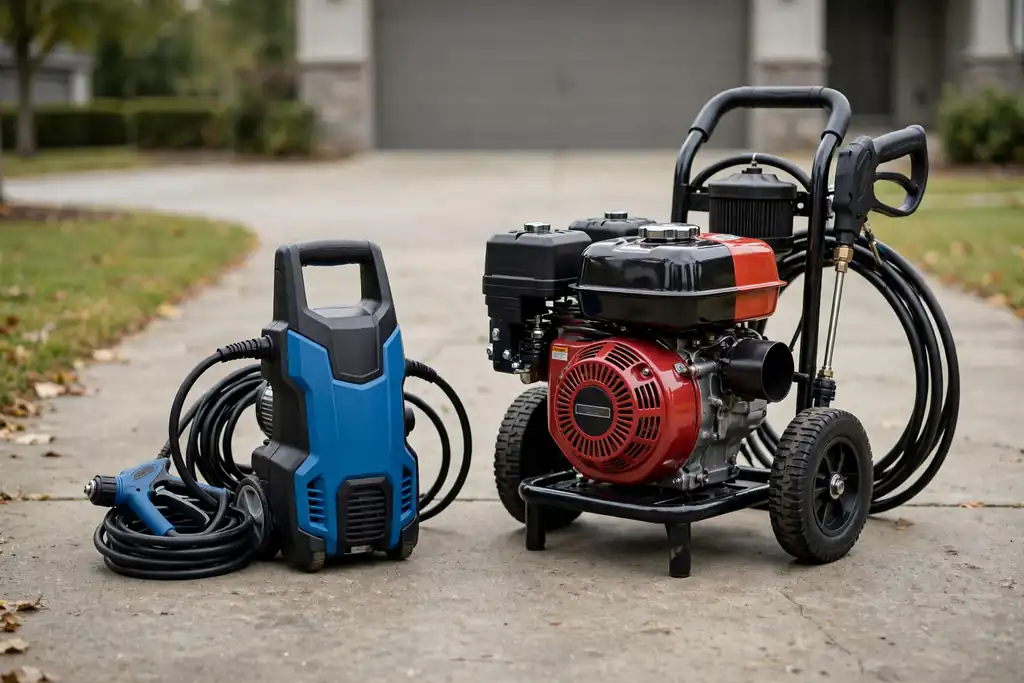
The short answer: Power washers and pressure washers are not exactly the same. Both use high-pressure water to clean surfaces, but a power washer heats the water before spraying it, while a pressure washer uses unheated water at high pressure. This single difference in water temperature creates two distinct machines with different strengths, applications, and ideal use cases.
Understanding this distinction matters because choosing the wrong machine can damage surfaces, waste time, or fail to remove the type of grime you are actually dealing with. This guide breaks down every meaningful difference, covers all key components, compares brands, and answers the most searched questions so you can make an informed decision.
What Is a Pressure Washer and How Does It Work
A pressure washer is a mechanical cleaning device that uses a motorized pump to force water through a narrow spray nozzle at significantly higher pressure than a standard garden hose. The output pressure is measured in PSI (pounds per square inch), and the flow rate is measured in GPM (gallons per minute). Together, these two values determine the machine’s cleaning units (CU), calculated by multiplying PSI × GPM.
The core operating principle is straightforward: water enters the machine from a connected water supply line or garden hose connection, passes through a high-pressure pump, and exits through a trigger gun, lance wand, and interchangeable spray nozzle tips. The pump is powered by either an electric motor or a gasoline engine, depending on the model.
Pressure washers do not heat the water. They rely entirely on the mechanical force of pressurized water to dislodge dirt, algae, mud, and loose paint from surfaces. This makes them highly effective for everyday residential cleaning tasks like washing cars, decks, patios, siding, and driveways.
Key Components of a Pressure Washer
Every pressure washer shares a set of foundational components regardless of brand or size:
- High-pressure pump: The core of the machine, typically a triplex plunger pump or axial cam pump. Triplex pumps are more durable and found on professional-grade units.
- Motor or engine: Electric models use universal motors or induction motors. Gas models use OHV engines (overhead valve engines) from brands like Honda, Briggs & Stratton, or Kohler.
- High-pressure hose: A reinforced hose rated to handle the output PSI, typically with 3/8-inch or 1/4-inch inner diameter.
- Trigger gun (spray gun): A hand-held valve that releases pressurized water when the trigger is depressed.
- Lance wand (extension wand): A rigid or semi-flexible tube that extends the reach of the spray.
- Nozzle tips: Color-coded interchangeable tips — red (0°), yellow (15°), green (25°), white (40°), and black (soap/low pressure) — that control spray angle and intensity.
- Detergent tank or injector: An onboard detergent tank or a downstream chemical injector that introduces cleaning solutions into the water stream.
- Unloader valve: A safety valve that redirects water flow when the trigger is not engaged, protecting the pump from pressure buildup.
What Is a Power Washer and How Is It Different
A power washer performs the same basic function as a pressure washer — it delivers a high-pressure water stream — but it incorporates a water heating element into the system. This heating element, typically fueled by propane, diesel, natural gas, or electric coil heating, raises the water temperature to between 180°F and 330°F (82°C to 166°C) before it exits the nozzle.
The hot water, often in the form of pressurized steam, does two things that cold water cannot: it breaks down grease, oil, and petroleum-based contaminants through thermal action, and it sanitizes and kills bacteria, mold spores, and pathogens on contact. This is why power washers are standard equipment in commercial kitchens, food processing plants, auto repair shops, and industrial facilities.
Key Components Unique to a Power Washer
Beyond the components shared with pressure washers, a power washer includes:
- Heating coil or burner unit: A coiled steel tube surrounded by a combustion chamber where fuel burns and heats the water as it passes through.
- Fuel tank: A storage tank for diesel or propane that powers the burner.
- Thermostat and temperature controls: Sensors and controls that regulate output water temperature and prevent overheating.
- Boiler assembly: In steam-capable units, a pressurized boiler system brings water to near-steam temperatures.
- Safety relief valve: A critical safety feature that releases pressure if temperatures exceed safe thresholds.
Power washers are physically larger, heavier, and significantly more expensive than equivalent pressure washers. A commercial-grade power washer can weigh over 500 lbs and cost between $3,000 and $15,000+, compared to a residential pressure washer that may weigh 25–50 lbs and cost $150–$600.
Are Power Washers and Pressure Washers Used Interchangeably in Common Language
In everyday speech and consumer marketing, the terms “power washer” and “pressure washer” are frequently used interchangeably. Major retailers like Home Depot, Lowe’s, and Amazon often list products under both terms regardless of whether they actually heat the water. Brands like Karcher, Sun Joe, Greenworks, Simpson, Ryobi, DeWalt, and Generac market their cold-water units as either “pressure washers” or “power washers” depending on marketing preference rather than technical accuracy.
This consumer-level overlap is important to understand because when someone says they want a “power washer” to clean their driveway, they almost certainly mean a cold-water pressure washer. True hot-water power washers are predominantly a commercial and industrial product, not a residential one.
From a technical and professional standpoint, however, the difference is well-defined:
- Pressure washer = high-pressure cold water
- Power washer = high-pressure heated or hot water
- Steam cleaner = very high-temperature water/steam at moderate pressure (a third related category)
Types of Pressure Washers vs. Types of Power Washers
Types of Pressure Washers
1. Electric Pressure Washers Powered by a 120V or 240V electric motor, these are the most common residential units. They produce 1,200–2,400 PSI and 1.0–2.0 GPM. Brands like Sun Joe, Greenworks, Ryobi, and Karcher dominate this segment. They are lightweight, quiet, require minimal maintenance, and are ideal for cars, bikes, outdoor furniture, and small patios.
2. Gas-Powered Pressure Washers Equipped with gasoline engines, these produce 2,000–4,400 PSI and 2.0–5.0 GPM. They are used by professional contractors, landscapers, and homeowners with large properties. Popular models come from Simpson Cleaning, Generac, Briggs & Stratton, and DeWalt. Gas models are portable without an electrical cord but require more maintenance, including oil changes, air filter replacements, and spark plug checks.
3. Battery-Powered (Cordless) Pressure Washers A newer category powered by lithium-ion battery packs (typically 18V–60V). Brands like Ryobi, Greenworks, and Milwaukee have entered this space. These produce lower pressure (600–1,500 PSI) and are best for quick rinse jobs, camping, and portable cleaning scenarios.
4. Hot Water Pressure Washers (Power Washers) These are the true power washers — cold water input, heated output. Available in electric-heated, diesel-heated, and propane-heated versions. Brands like Karcher HDS Series, Landa, Hotsy, Mi-T-M, and Alkota are leaders in industrial hot-water units.
Types of Power Washers by Heat Source
- Diesel-fired power washers: Most common in industrial settings due to fuel efficiency and high heat output. Used in construction sites, trucking fleets, and manufacturing.
- Propane-heated power washers: Common in food service, restaurant kitchen cleaning, and applications where diesel fumes are not acceptable indoors.
- Electric-heated power washers: Used in enclosed spaces where combustion is not permitted. Slower to heat than fuel-fired models but safer for indoor use.
- Steam power washers: Produce very low water volume at extremely high temperature, often used in graffiti removal, sanitization, and medical facility cleaning.
Power Washer vs. Pressure Washer: PSI, GPM, and Cleaning Power Compared
Understanding the measurable performance specs helps clarify when to use each type. PSI measures force, GPM measures volume, and cleaning units measure total impact.
Pressure Ratings Explained
- Under 2,000 PSI (Light Duty): Safe for cars, windows, patio furniture, and bicycles. Electric residential units.
- 2,000–3,200 PSI (Medium Duty): Suitable for decks, fences, driveways, and sidewalks. Mid-range gas or heavy electric models.
- 3,200–4,500 PSI (Heavy Duty): For concrete, brick, paint stripping, and fleet vehicles. Professional gas models.
- Above 4,500 PSI (Extra Heavy Duty): Industrial demolition cleaning, surface preparation before industrial coatings. Power washers at this level are typically hot-water units.
The addition of heat in power washers allows them to clean effectively at lower PSI because hot water softens and dissolves contaminants chemically, reducing the mechanical force needed. A 180°F power washer at 2,500 PSI can outperform a cold-water pressure washer at 4,000 PSI on grease-contaminated surfaces.
Comparison Table: Power Washer vs. Pressure Washer
| Feature | Pressure Washer | Power Washer |
|---|---|---|
| Water Temperature | Cold (ambient temperature) | Hot (180°F–330°F / 82°C–166°C) |
| Primary Cleaning Method | Mechanical force (pressure) | Mechanical force + thermal action |
| Best For | Dirt, mud, mildew, algae, dust | Grease, oil, bacteria, heavy industrial grime |
| Typical PSI Range | 1,200–4,400 PSI | 1,500–4,000 PSI |
| Typical GPM Range | 1.0–5.0 GPM | 2.0–6.0 GPM |
| Power Source | Electric or gasoline | Electric, diesel, propane, natural gas |
| Average Weight | 25–80 lbs | 200–600+ lbs |
| Typical Cost Range | $100–$800 (residential) | $1,500–$15,000+ |
| Surface Damage Risk | Moderate (depends on PSI) | Low on contamination; high if misused |
| Sanitization Ability | None | High (kills mold, bacteria, pathogens) |
| Maintenance Level | Low to moderate | High (burner, fuel system, heating coil) |
| Portability | High | Low to moderate |
| Common Users | Homeowners, contractors | Restaurants, auto shops, food plants |
| Popular Brands | Karcher, Sun Joe, Simpson, Ryobi | Karcher HDS, Hotsy, Landa, Alkota |
| Detergent Compatibility | Yes (cold-water detergents) | Yes (hot-water-rated detergents required) |
When to Use a Pressure Washer vs. a Power Washer
Best Applications for a Pressure Washer
A cold-water pressure washer is the right tool for the following jobs:
- Residential driveway cleaning: Removing dirt, tire marks, and surface staining from concrete, asphalt, and pavers.
- Deck and fence washing: Clearing algae, mildew, and weathered wood discoloration before staining or sealing. Use green (25°) or white (40°) nozzle tips to avoid wood splintering.
- Vehicle washing: Cars, trucks, motorcycles, RVs, and boats. Use low pressure (under 1,800 PSI) and a wide-angle nozzle to prevent paint damage.
- Siding cleaning: Vinyl, aluminum, fiber cement, and brick siding respond well to pressure washing combined with a mild detergent applied through a soap nozzle.
- Patio furniture: Clearing seasonal grime from plastic, resin, and metal outdoor furniture.
- Roof soft washing: Not direct pressure, but using a low-pressure downstream chemical injection to apply sodium hypochlorite (bleach-based solutions) for moss and algae removal on asphalt shingles.
Best Applications for a Power Washer
A hot-water power washer excels in scenarios where cold water cannot chemically break down the contaminant:
- Commercial kitchen floor and equipment cleaning: Hot water dissolves cooking grease, animal fats, and food residue in minutes rather than hours.
- Automotive and heavy equipment degreasing: Engine bays, differential housings, axles, and undercarriage components in fleet maintenance facilities.
- Food processing plant sanitation: USDA and FDA-regulated food facilities require regular hot-water cleaning to meet hygiene standards.
- Graffiti removal: Steam-temperature water softens spray paint and adhesive-backed tags from concrete and brick surfaces.
- Hospital and medical facility cleaning: Surface pathogen elimination requires water temperatures above 160°F, which only a power washer can achieve.
- Livestock and agricultural equipment: Removing manure, blood, and biological matter from barn floors, troughs, and farm equipment.
Common Mistakes When Choosing or Using These Machines
Many homeowners and even contractors make avoidable errors when selecting or operating pressure washers and power washers. Understanding these mistakes saves equipment, surfaces, and safety.
Mistake 1: Using Too High a PSI for Delicate Surfaces Applying a 0° or 15° nozzle tip or using above 2,000 PSI on wood decking, painted surfaces, or vehicle exteriors causes surface etching, paint stripping, and wood fiber damage. Always start with the widest angle nozzle and test on an inconspicuous area.
Mistake 2: Assuming a “Power Washer” from a Retailer Is Actually Hot Water Most consumer products labeled “power washer” at retail stores like Home Depot or Walmart are standard cold-water pressure washers. If you genuinely need hot water for grease removal, verify that the unit includes a burner assembly and fuel system, not just a motor and pump.
Mistake 3: Running a Gas Pressure Washer Without Oil or Water Supply Operating a gas pressure washer with insufficient pump oil causes catastrophic pump failure. Running it without a water source connected causes pump cavitation and seal damage. Always check oil levels and ensure full water supply before starting.
Mistake 4: Using Cold-Water Detergents in a Hot-Water Power Washer Hot-water units require hot-water rated chemical concentrates. Using cold-water formulas at high temperatures causes excessive foaming, chemical breakdown, and potential damage to internal seals and the heating coil.
Mistake 5: Ignoring Nozzle Distance from Surface Even at correct PSI settings, holding a nozzle less than 6 inches from a surface concentrates pressure to dangerous levels. Maintain at least 12–18 inches on most hard surfaces and 24+ inches on soft materials and painted surfaces.
Mistake 6: Pressure Washing on Freezing Days Using a pressure washer in temperatures below 32°F (0°C) without draining residual water from the pump causes pump cracking and hose damage due to ice expansion. Always winterize the pump with pump saver / antifreeze solution before storage in cold climates.
Mistake 7: Neglecting PPE (Personal Protective Equipment) High-pressure water at 3,000+ PSI can penetrate skin and cause injection injuries — a medical emergency requiring immediate surgical intervention. Always wear safety goggles, closed-toe shoes, and avoid pointing the spray gun at people or animals.
Step-by-Step Guide: Choosing Between a Power Washer and Pressure Washer
Follow this decision framework before purchasing or renting:
Step 1: Identify the contaminant type Ask yourself what you are actually cleaning. Is it dirt, algae, and grime? Go with a pressure washer. Is it grease, oil, bacteria, or industrial residue? You need a power washer.
Step 2: Determine the surface material Soft surfaces (wood, painted siding, vehicle paint) need low PSI and wide nozzle angles. Hard surfaces (concrete, brick, metal) tolerate higher PSI. Hot water power washers require even more care on painted or heat-sensitive surfaces.
Step 3: Assess frequency and scale of use For occasional residential use (a few times per year), a light-duty electric pressure washer in the 1,600–2,000 PSI range is perfectly sufficient. For weekly commercial use, a gas-powered professional pressure washer or a dedicated hot-water power washer is the appropriate investment.
Step 4: Consider portability and power availability Electric pressure washers need an outlet within cord reach or via heavy-duty extension cord (12-gauge minimum). Gas models go anywhere fuel is available. Hot-water power washers on trailers are the most portable for commercial use but require fuel supply.
Step 5: Set a realistic budget Account not just for purchase price but for detergent costs, replacement nozzles, hose repairs, pump maintenance, and fuel. A cheap pressure washer with an axial cam pump may last only 50–100 hours, while a unit with a triplex pump can exceed 500 hours with proper maintenance.
Step 6: Check brand support and part availability Choose brands with strong service networks. Karcher, Simpson, Generac, and DeWalt have wide dealer networks for parts. For commercial hot-water units, Hotsy, Landa, and Mi-T-M offer service contracts and parts programs.
Frequently Asked Questions
Are power washers and pressure washers the same thing for home use?
For almost all home use purposes, a pressure washer is what you need and what most retailers sell as either a “power washer” or “pressure washer.” True hot-water power washers are commercial and industrial machines not typically practical for home ownership due to cost, size, and complexity. A cold-water electric pressure washer at 1,600–2,400 PSI handles the vast majority of residential cleaning jobs effectively.
Can a pressure washer kill mold the same way a power washer does?
A standard pressure washer can physically remove mold from surfaces using mechanical force, but it does not kill the mold spores. Surviving spores quickly regrow. A power washer with water above 160°F kills mold organisms on contact. For cold-water pressure washing of mold, you must combine it with a fungicidal detergent such as sodium hypochlorite solution to achieve effective mold elimination.
Are power washers and pressure washers equally effective on concrete driveways?
Both can clean concrete driveways effectively, but hot-water power washers are far superior for concrete contaminated with oil stains, fuel spills, and automotive fluids. Cold-water pressure washers work well for surface dirt, tire marks, and general weathering on concrete. For residential driveways, a gas pressure washer at 3,000 PSI with a surface cleaner attachment is typically the most efficient and practical option.
Are power washers and pressure washers safe to use on wood decks?
Both can be used on wood decks, but require careful technique. On wood, use a 25° (green) or 40° (white) nozzle tip, maintain at least 18 inches of distance, and never exceed 1,500–2,000 PSI for treated or weathered wood. Hot-water power washers carry additional risk on wood because heat can raise grain, cause warping, or damage sealants already in the wood. Cold-water pressure washers are generally recommended for wood deck cleaning.
Are power washers and pressure washers the same when it comes to car washing?
No. For washing vehicles, a low-pressure pressure washer (under 1,900 PSI) with a 40° nozzle tip and car wash foam detergent is the correct tool. Hot-water power washers should not be used on car paint, rubber trim, or plastics because the heat causes paint softening, rubber drying, and adhesive failure on trim pieces and decals. Always maintain at least 12 inches from painted surfaces even with low-pressure cold water.
Are power washers and pressure washers the same in terms of water consumption?
Both use significantly less water than a garden hose for equivalent cleaning tasks. A standard garden hose flows at 8–12 GPM, while a pressure washer operates at 1.5–4 GPM. Despite using less water, they clean more effectively due to the pressure differential. Power washers use comparable water volumes but the heated water reduces the total time spent cleaning, often resulting in less total water consumption per job.
Are power washers and pressure washers the same for removing paint?
Both can strip paint, but the approach differs. A pressure washer requires a 0° (red) or 15° (yellow) nozzle tip at high PSI (3,000+) to strip old paint from concrete or metal. A hot-water power washer can strip paint more efficiently at lower PSI because heat softens the paint bond before the water impact dislodges it. Neither should be used for lead paint removal without containment protocols — lead dust and chips require specialized collection under EPA and OSHA regulations.
Are power washers and pressure washers the same regarding rental options?
Both are available at equipment rental companies like Home Depot Tool Rental, Sunbelt Rentals, and United Rentals. Cold-water pressure washers typically rent for $60–$120 per day. Hot-water power washers rent for $150–$350 per day due to their commercial-grade nature. Rental is a smart option for one-time jobs like pre-sale home prep or annual driveway deep cleaning where ownership does not justify the cost.
Are power washers and pressure washers the same when winterizing and storing them?
The winterization process differs meaningfully. For a cold-water pressure washer, the standard procedure is running pump protector/antifreeze solution through the pump, draining all hoses, and storing in a heated space above freezing. For a hot-water power washer, the process also includes flushing the heating coil, draining the fuel lines if propane/diesel-fired, and following the manufacturer’s burner shutdown procedure to prevent residual combustion gases and fuel contamination.
Conclusion
Power washers and pressure washers are not the same machine, even though the terms are used interchangeably in casual language and retail marketing. The defining difference is water temperature: a pressure washer delivers cold high-pressure water, while a power washer delivers hot high-pressure water. For residential cleaning tasks including driveways, decks, vehicles, and siding, a quality cold-water electric or gas pressure washer is sufficient, practical, and cost-effective. When the job involves grease, oil, bacteria, or industrial contamination, a hot-water power washer is the technically correct tool. Knowing this distinction ensures you select the right machine, protect surfaces from damage, achieve professional cleaning results, and spend your budget appropriately.